The outcome:

Measuring completion rate and time recovered post-launch.

The problem:

Patients answered risk assessments cold, in the room, making consultations longer and the answers less reliable.

Timeline and team size.

2 months, team of 5 (Product Designer (myself), CEO, CTO, Marketing and Medical). My responsibility was designing the flow, testing it with users. I shared the initial phase with

The company.

Nuumad is a digital consultation platform for pharmacists.

01 CONTEXT

Nuumad: online consultation platform for healthcare professionals (HCP).

Nuumad helps pharmacists run consultations with digital PGDs. The USP and pain points were already validated, and the business goal was retention and acquisition, so the work was about deepening an existing product, not proving a new one.

02 PROBLEM DISCOVERY

Where the time was going

Our users spent longer on the risk-assessment page than any other, and check-in calls kept surfacing the same friction. The only way to access and run the RA was during the consultation. To understand the impact, we ran 14 structured interviews with both HCPs and patients.

Here's the HCP's view of risk assessment

03 INSIGHTS

Same room, same moment, four different reasons

Five findings stood out across the interviews. Read together, they weren't five separate complaints, they pointed at one shared moment where the current flow breaks down.

I (HCP) have to record the patient's answers to the risk assessment at the beginning of the appointment.

I (patient) can't think in peace about the answers or look into my medical history because I feel rushed to answer.

Sometimes I'm not exactly sure about the answers, because it's not something I answer every day.

Some of the questions are quite intimate and I don't feel comfortable answering them in the office.

A family member is more knowledgable abut my medical history, but they aren't with me at the appointment.

04 SYNTHESIS

4 symptoms - not 4 problems

Time pressure, recall, and privacy looked like distinct issues, but they shared one root: patients answer at the worst possible moment. Naming that root (the when and where of answering) is what let me define the problem instead of chasing three causes at once.

Time pressure

Recall

Privacy

the when and where of answering

Lengthy and possibly inaccurate consultations

05 PROBLEM DEFINITION & HYPOTHESIS

Hypothesis

The shift was moving from the HCP's point of view to the patient's. I framed the problem, wrote a falsifiable hypothesis, and defined upfront what would prove me wrong at the problem level (not just what would prove a design wrong) alongside the signals that would tell me it worked.

Usually, before forming a hypothesis, I'd run a prioritisation session to understand which problem should be a priority. In this case, the interviews showed a clear pattern and I was able to move straight to problem definition. The criteria for prioritisation are: frequency & reach, severity, strategic fit, evidence strength, tractability.

THE PROBLEM

A patient is trying to give accurate risk-assessment answers, but they're answering cold in the appointment — no time to think, no access to their records, no privacy — which makes the consultation longer and their answers less confident and reliable.

THE HYPOTHESIS

If we let patients answer before and outside the appointment, they'll answer more confidently and accurately and the consultation will shorten, because the blocker is the moment, not the questions.

Patients are either unsure about their medical history or intimidated about the intimate questions, which makes the consultation uncomfortable and lengthy, and patients feel less confident in the information they provide.

WE'D KNOW WE WERE WRONG IF

01 The questions patients stumble on are the same ones they can't answer anywhere — the intimate or genuinely-don't-know ones.

02 Patients report they'd be equally unsure answering at home as in the office.

03 Patients given time + records + privacy who still answer hesitantly

SUCCESS LOOKS LIKE

The outcome: patients arrive having answered the RA accurately and confidently, and the RA no longer eats consultation time.

  • Leading signals test day to day): share of patients who complete the RA before the appointment, how long it takes them, their self-reported confidence at the point of answering, and how many questions they leave flagged as "not sure."

  • Lagging signals (prove it worked): time the HCP spends on the RA portion, and how often the HCP has to correct or overturn what the patient entered.

THE CONSTRAINTS

  • The HCP must still edit or comment on patient's answers

  • Limited resource (1 engineer and 1 designer)

06 DIVERGENCE

3 comparable options

Every approach could have its riskiest assumption tested by hand, before any build — a desk audit, a Wizard-of-Oz send, a human walkthrough. I sequenced by what each test would teach for the least cost, killed the heaviest option in an afternoon, and let the evidence point to the answer.

Option A: Pre-fill & verify

Riskiest assumption

The info the RA needs actually lives in a record you can pull

Bets the cause is:

Missing information: patients can't recall what isn't in front of them

Patient experiences:

Form pre-filled from their record; they confirm, correct, or flag

Rests on:

Most RA answers already exist in records; verifying beats recalling

Cheapest test:

Desk audit: what % of RA questions are answerable from records? No build.

Build: heaviest

Option B: Private async form

Riskiest assumption

Patients actually complete it ahead of the appointment

Bets the cause is:

Pressure and setting: rushed, watched, in the room

Patient experiences:

Blank form on their own device, at home, untimed, private

Rests on:

Patients have the answers; only time and privacy are missing

Cheapest test:

Wizard-of-Oz: send RA to a few patients ahead via existing channel; watch completion + quality

Build: lightest

Option C: Guided prep

Riskiest assumption

Comprehension is the bottleneck: and a guide can explain safely

Bets the cause is:

Comprehension and confidence: unclear what's asked or what's "right"

Patient experiences:

Guided flow explains each question; "not sure" is a valid answer

Rests on:

Questions are opaque or intimidating, not unknown or rushed

Cheapest test:

Human walks a few patients through verbally; does confidence jump?

Build: heaviest
My thinking & decision:

  • Every one of the three approaches can have its riskiest assumption validated manually, before any build. No engineering effort is committed to learn whether a bet is even alive.

  • That reframes prioritisation entirely. I'm sequencing by what each test teaches for the least cost. Approach A is the clearest example: it's the most expensive thing to build (it needs records integration), but its make-or-break assumption - that the RA's answers actually live in a record I can pull from - is answerable in an afternoon with nothing but the question list in front of me. So it goes first.

  • If the records don't hold the answers, I've killed the heaviest option before lunch; if they do, I've cleared the runway to build it with confidence. Either way I've spent an afternoon, not a sprint.

07 MANUAL TESTS

Deciding what to build

Every approach could have its riskiest assumption tested by hand, before any build: a desk audit, a Wizard-of-Oz send, a human walkthrough. I sequenced by what each test would teach for the least cost, killed the heaviest option in an afternoon, and let the evidence point to the answer.

Option A: Pre-fill & verify

Assumption

The info the RA needs actually lives in a record you can pull

Test outcome

Desk audit of the questionnaire:

  • only a minority of items were answerable from existing records; most are current-state or lifestyle.

  • most of the pharmacy's records live offline - on paper

Killed - one afternoon

Option B: Private async form

Assumption

Patients actually complete it ahead of the appointment

Test outcome

Wizard-of-Oz sent to some patients:

  • most completed before arriving,

  • answers came back fuller and more confident

  • even if some weren't filled, users had a basic information

Validated and selected

Option C: guided prep

Assumption

Comprehension is the bottleneck: and a guide can explain safely

Test outcome

Human walkthrough:

  • helped a little, but confidence rose mainly from time, not explanation, so cause was secondary

  • used the 'Not sure' learning and merged it with Option B

Parked

My thinking & decision:

  • The blocker was the moment of answering, not missing data or unclear questions. Move the RA before the appointment, patient-led and private, with the HCP reviewing, carrying a little of C's "not sure" handling into B.

08 SERVICE BLUEPRINT

Current and proposed service pathways

Mapping both states across every lane showed exactly what changes — and what doesn't. The patient's answering moment moves before the appointment, the HCP shifts from data entry to review, and the clinician stays the authority over the record throughout.

Today — risk assessment answered live, in the room

LaneBeforeDuring appointmentAfter
PatientBooks visit, no prepAnswers cold, on the spot — rushed, unsure, exposed on intimate itemsLeaves; some answers were guesses
Frontstage HCPReads questions aloud, types answers, waits while patient thinksProceeds on possibly shaky data
BackstageVisit scheduledRA module open in EHR, clinician-enteredRA stored in record
SystemsSchedulingEHR RA form; clock running in-roomRecord updated

Proposed — patient-led, private, clinician-reviewed

Shaded cells mark what changed from today.

LaneBeforeDuring appointmentAfter
PatientGets a private link, fills RA at home, untimed — can check records, flag "not sure"Reviews with HCP; time spent only on flagged or sensitive items
Frontstage HCPSystem sends invite + reminderSees pre-filled answers; edits, comments, confirms — stays the authorityFinalises record
BackstageRA generated + sent; responses held as draftDraft surfaced in EHR for review, not re-entryConfirmed RA committed, edit trail kept
SystemsSecure patient form + draft storageEHR shows patient draft with edit/commentAudit trail of clinician edits

Shaded = changed from current state

My thinking & decision:

  • Now I know what needs changing in the service blueprint. This means I can move to start writing requirements

09 REQUIREMENTS

Definition of good

Before designing screens, I set goals, non-goals, and requirements, split into what makes the flow work (v1) and what makes it better (v2). The non-goals trace straight back to the approaches the tests ruled out, so scope was decided by evidence, not preference.

GOALS

Business

  • Recover in-appointment time by moving the RA out of the room

  • Enable more consultations per day

User

  • Answer confidently about their medical history

  • Feel supported when they don't know an answer

NON-GOALS

  • Replacing the in-appointment form: the HCP keeps authority over the record

  • Auto-populating answers from records

  • Building HCP-side analytics or reporting

  • Changing the RA questions

  • A comprehension guide

REQUIREMENTS

V1

  • Patients can answer without setting up an account

  • State persists: patients return to where they left off

  • HCP can comment on answers (not edit) keeping patient voice and clinician note distinct

  • Patients can submit with items flagged "not sure"; the HCP sees the flags

  • If not submitted before the appointment, the RA reverts to in-appointment with no loss

  • Form locks once the consultation takes place

  • HCP sees the form only once the patient has submitted it

  • Responses handled securely — visible only to the assigned HCP after submission

V2

  • Patients are sent reminders to complete ahead (form works without it; manual nudge covers day one)

  • Lock-time updates automatically when an appointment is rescheduled (handle manually at first)

10 UX FLOW

The flow, end to end

Every v1 requirement shows up here as a branch or a state — the not-completed fallback, the per-question "not sure" flag, the two locks. Two actors, one handoff at submission, both paths converging at the consultation.

11 UX & UI DECISIONS

From flow to interface

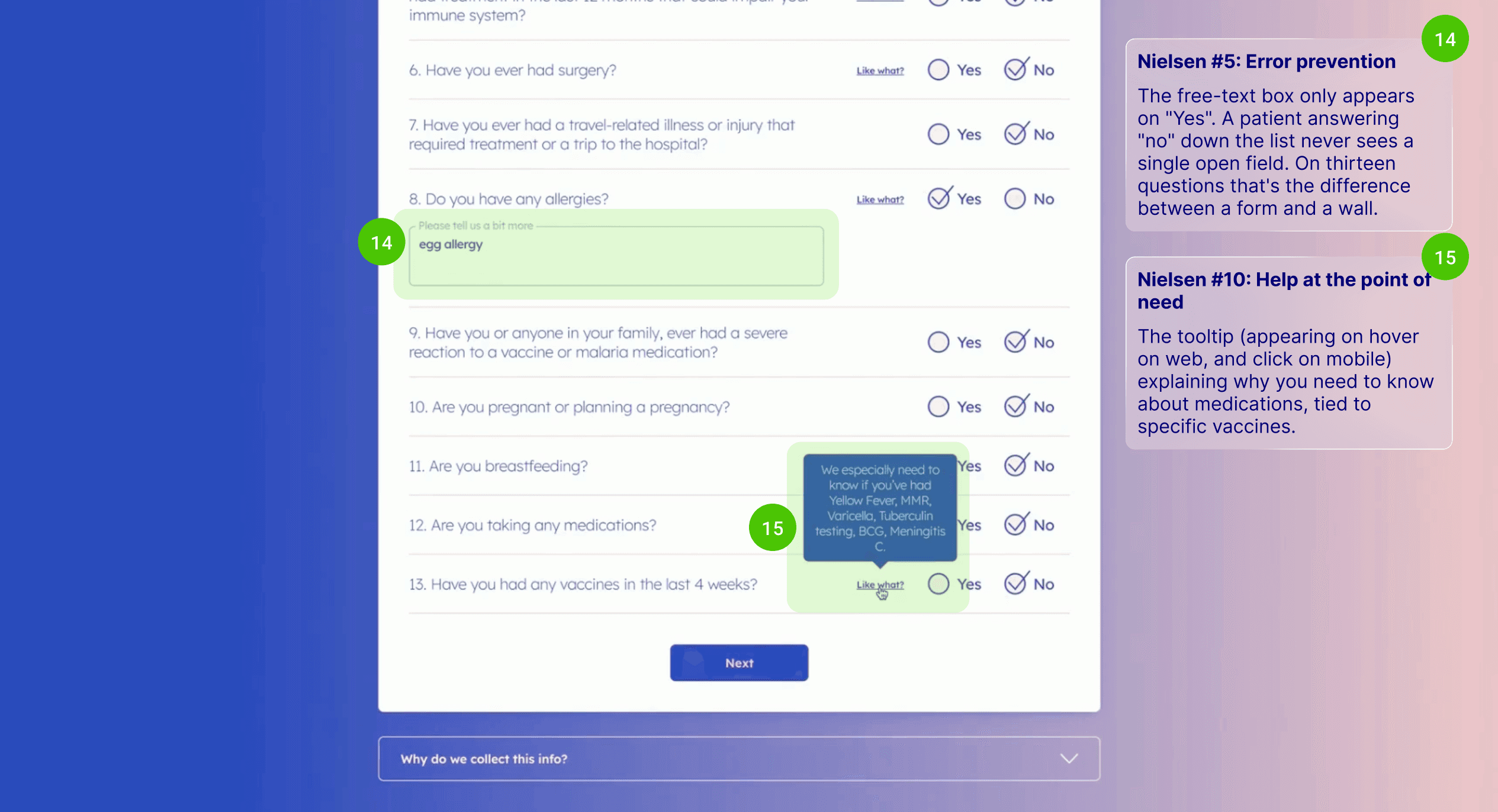
Where the logical states become real screens: the patient's private entry, the "not sure" option on each question, and the ability to add more comments. Below you can find the annotated screens with decisions behind them. Click the right arrow to view more screens.

12 UNHAPPY PATHS

Edge cases I designed for

A flow is only as good as its unhappy paths. Each one here traces back to an insight from research or a requirement I set before designing.

The patient doesn't know the answer

The situation

Interviews were clear that patients often can't answer confidently ("it's not something I answer every day."). A binary yes/no forces a guess, and a guess is worse than an admission, because the HCP can't tell the difference.

What I did

Gave uncertainty a home at three levels of granularity, rather than one catch-all.

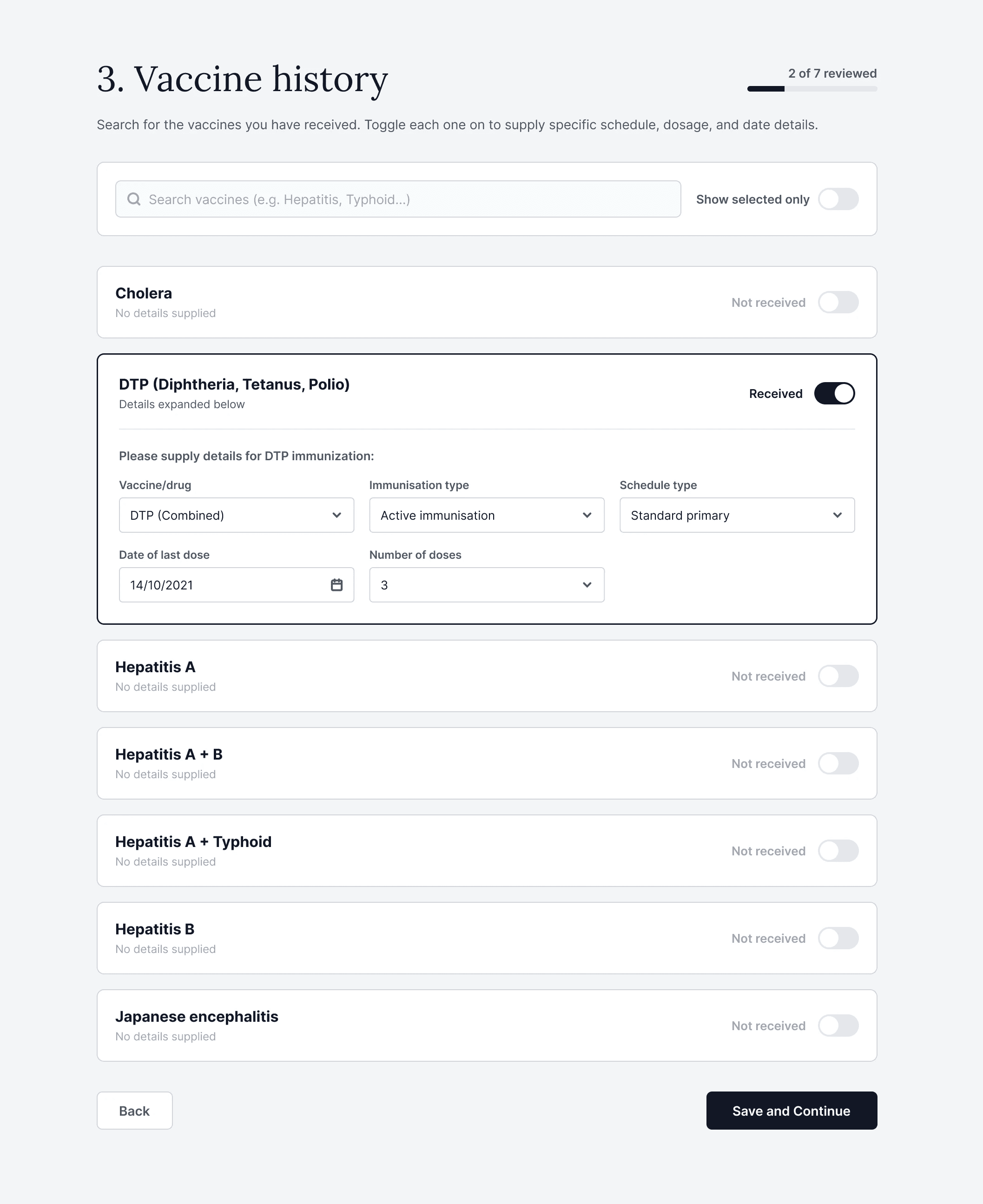
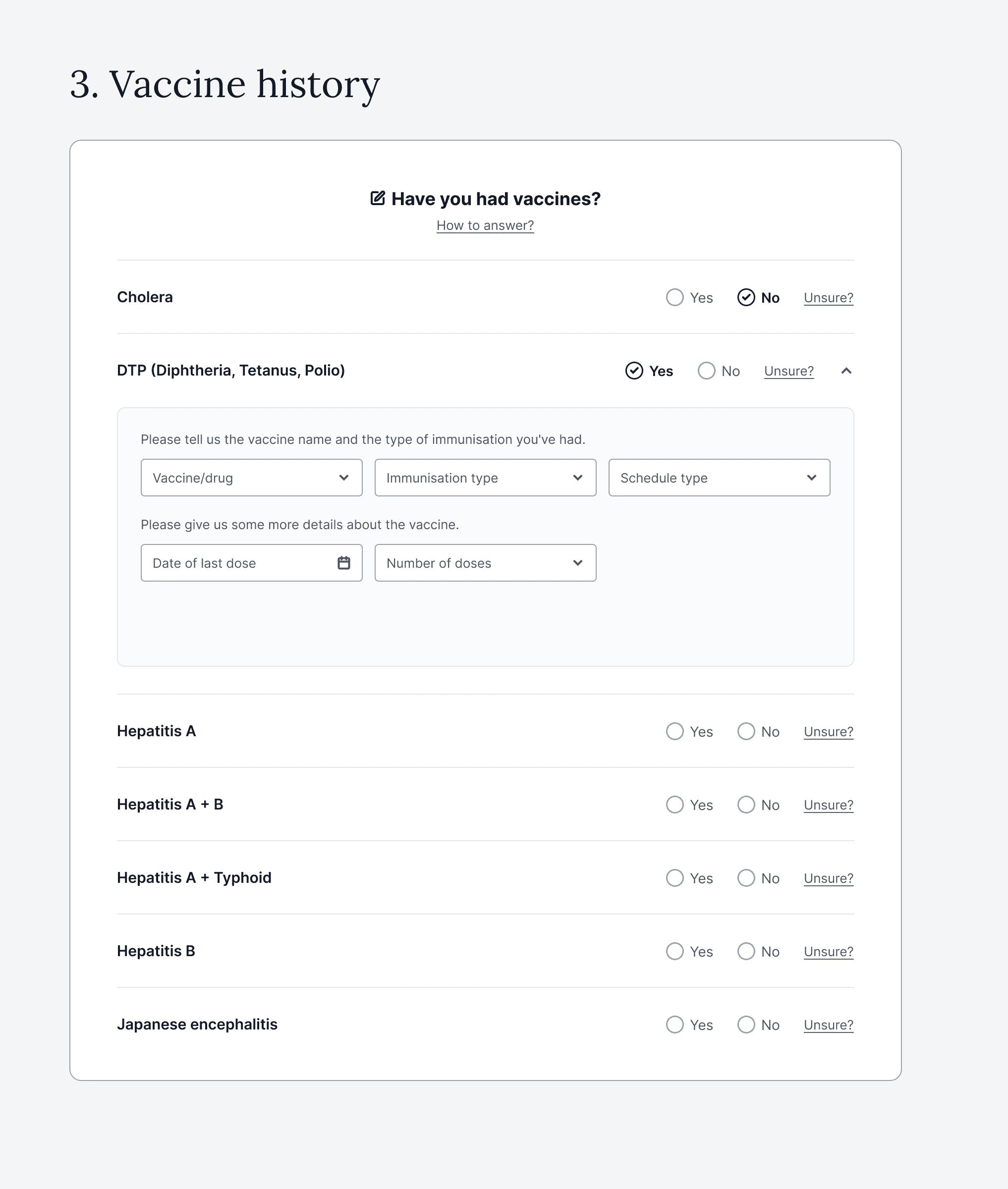
  • Unsure whether you had it: "Unsure?" on every row, carried consistently across steps

  • Unsure which vaccine it was: "Unknown" as a first-class option in the dropdown

  • Unsure about the details: guidance stating an approximate date is acceptable

Why it matters

This is error prevention at the source (Nielsen #5) rather than validation after the fact. It also protects the signal: the HCP sees where the patient was uncertain instead of receiving a confident-looking answer that isn't.

The patient submits, then remembers something

The situation

Answers are locked to the patient at submission, so the HCP reviews a stable set. But people remember things afterwards. That's the nature of recall.

What I did

Chose the one-way gate deliberately and told the patient before they commit, rather than letting them discover it. Anything remembered afterwards is raised in the consultation, where the HCP can comment on the record.

Why it matters

Post-submission editing would help the patient but undermine the clinician's confidence that what they reviewed is what they'll discuss. In v1 I chose reviewer trust; revisiting this is a v2 question.

Edge case branches

The situation

Not every edge case is a screen. Most are branches. These are resolved in the flow logic rather than a bespoke interface.

What I did

  • User never opens the form → reverts to in-appointment RA, with no loss

  • Starts but doesn't finish → state persists; returns where they left off

  • Appointment rescheduled → lock time follows the consultation, not the original date

Why it matters

This is error prevention at the source (Nielsen #5) rather than validation after the fact. It also protects the signal: the HCP sees where the patient was uncertain instead of receiving a confident-looking answer that isn't.

13 FINAL FLOW

The flow from the patient's point of view

The end result, seen the way a patient meets it: an email before the appointment inviting them to complete the risk assessment privately, in their own time: the whole redesign, reduced to one calm moment before they arrive.

Create a free website with Framer, the website builder loved by startups, designers and agencies.